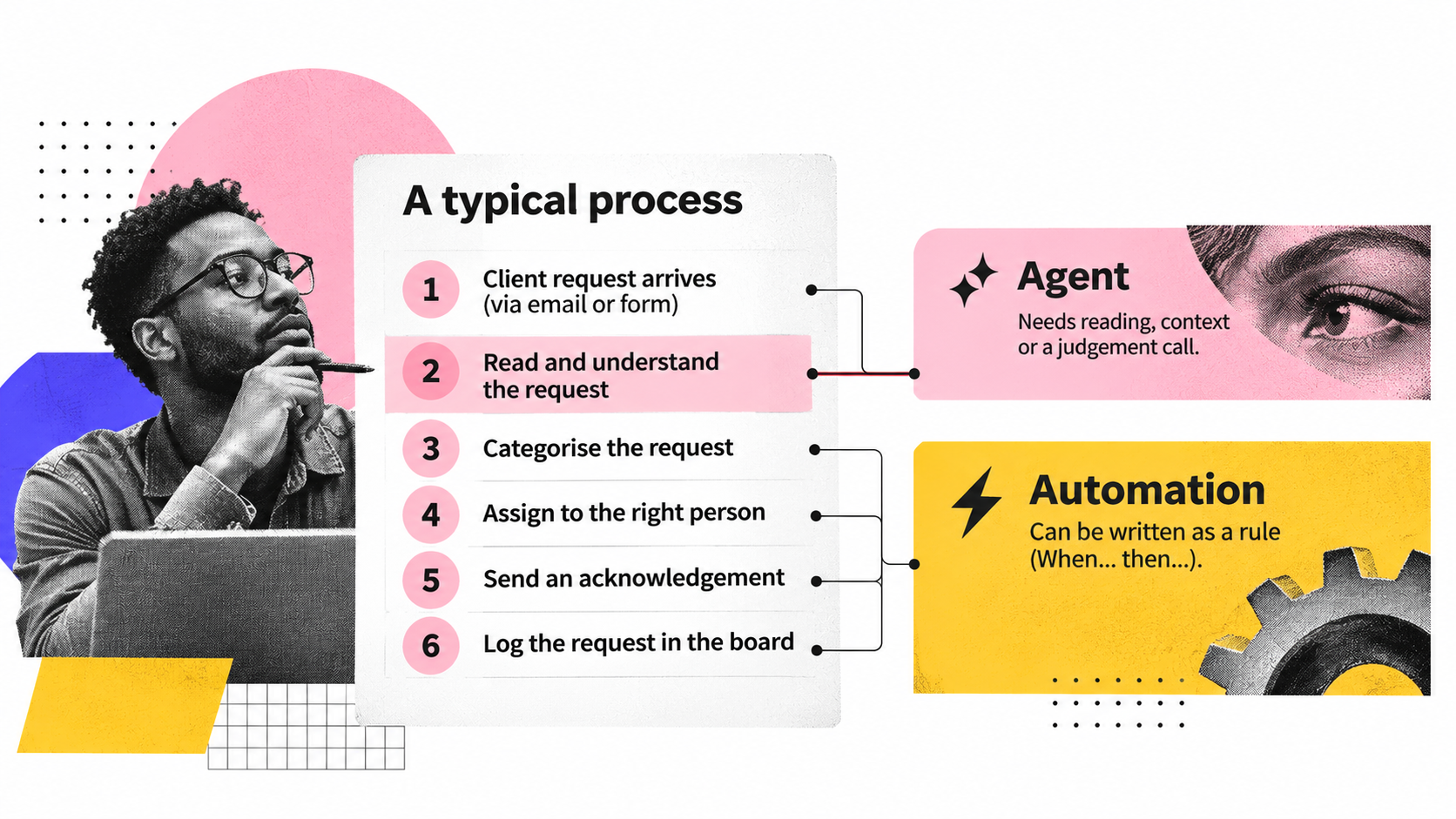
AI agents are everywhere at the moment. If you're already using automations in your business, you might be wondering what an agent can do that your existing setup can't.
It's a fair question. Both can take work off your team's plate, connect different systems and run tasks without someone having to do them manually.
The difference comes down to how they work and the decisions they can make along the way. Understanding that difference can save you from building an expensive AI solution for something a simple automation could handle.
We've been experimenting with both at mutherboard, and we've found that some of the most useful applications involve using them together.
Here's how to work out what belongs where.
What an automation doesAutomations follow rules you've already set.
You decide what should trigger an action, any conditions that need to be met and what happens next. Once you've set it up, the automation follows those instructions every time.
Think of it as a "when this happens, do that" process.
For example, in monday. com, you might set up automations to:
- Notify a project manager when a task becomes overdue.
- Create an onboarding checklist when a deal moves to "Won".
- Send a reminder when a deadline is approaching.
Tools like Make and Zapier can take this further by connecting different platforms. A new form submission could create a monday. com item, add a contact to your CRM and trigger a confirmation email.
The important thing is that you've defined the process in advance. The automation doesn't decide whether the next step makes sense. It follows the rules you've given it.
That makes automations particularly useful for repetitive tasks with predictable steps. They're relatively easy to test, and when something goes wrong, you can usually trace it back to a trigger, condition or action.
What an AI agent does differentlyAn AI agent has more freedom to work out what needs doing.
You give it an objective, access to relevant information and tools, and instructions about what it can and cannot do. The agent can then interpret the information it finds, decide which actions to take and adjust its approach as it works.
Anthropic explains this distinction in its guide to building effective agents. In a fixed workflow, the steps are predefined. An agent can decide which steps to take based on the task and the information available.
Imagine asking an agent to review a customer email, work out what the customer needs, check the relevant project and suggest the next action.
The email might contain a straightforward request, a complaint or several unrelated questions. You don't need to create a separate rule for every possible way the customer could phrase their message.
The agent can interpret the language and work out how to respond within the boundaries you've set.
That flexibility is useful when the work involves reading, interpreting, researching or making decisions based on information that changes from one task to the next.
It also introduces a different kind of risk. An automation can fail because a rule was configured incorrectly. An agent can misunderstand information or make a poor decision even when its instructions appear reasonable.
How we're using agents and automations togetherOne of our directors uses our AI agent called Milo.
Every day at 5 pm, Milo reviews the director's sent emails and Slack messages, looking for commitments he's made during the day.
These might be promises to send someone a document, follow up on a conversation or get something done by a particular date.
Milo checks those commitments against the director's tasks in monday. com. If something is missing, he creates the task.
A standard monday. com automation then sends the director an email summarising the new tasks.
The two technologies have different jobs.
Milo handles the part that requires interpretation. The monday. com automation handles the predictable part.
We could try to make an agent manage the entire process. There isn't much value in doing that when an existing automation can reliably handle the final step.
Where AI agents can become unnecessarily complicatedWe've also experimented with developing an agent to help scope client projects.
The idea was appealing. Give the agent information about a potential project, let it ask the right questions and use the answers to help develop a scope of work.
The difficulty is that our projects vary considerably.
Some have straightforward requirements. Others involve several systems, complex dependencies, multiple stakeholders or stage gates that need to happen in a particular order.
For an agent to scope these projects properly, it needs enough information to understand what it's dealing with.
That can lead to another problem: the agent asks lots of questions, including questions that aren't relevant to the particular project.
Suddenly, something designed to make scoping easier becomes another process for someone to manage.
The reverse problem happens with automations.
If you're building an increasingly complicated collection of conditions to account for every possible way someone might describe a request, you may be asking a rules-based system to do work that requires interpretation.
That's often a good point to consider an agent.
How to decide which one you needBefore building anything, we'd suggest asking three questions.
1. Can you describe the process as "when this happens, do that"?If the task has a clear trigger and a predictable next step, start with an automation.
For example, when a deal is marked as won, create an onboarding board and notify the account manager.
There's no need for an AI agent to decide what happens. You've already decided.
2. Does the task require someone to interpret information?If the next action depends on understanding an email, reviewing a document, researching an issue or making a judgement based on changing information, an agent may be more useful.
For example, reviewing customer correspondence to identify commitments is difficult to capture in a handful of automation rules.
The agent can do the interpretation, while automations can handle the routine actions that follow.
3. What happens if it gets the decision wrong one time in twenty?This is the question we'd spend the most time on.
If an agent incorrectly categorises an internal note, the consequences may be minor.
If it sends the wrong information to a customer, changes financial records or makes a commitment on behalf of your business, the consequences could be considerably more serious.
For higher-risk tasks, build in human review and approval before the agent takes action.
You can still use an agent to do the research, prepare a recommendation or draft the next step. The final decision stays with a person.
A few things to consider before you buildWhichever approach you choose, it's worth thinking through how the process will operate day to day.
Permissions matter. An agent should only have access to the systems and information it needs. Be specific about what it's allowed to read, create, edit or send.
Think about when the process should run. Some tasks work best on a schedule, like Milo's daily review. Others should be triggered by an event, such as a new customer enquiry or a change in project status.
Keep a record of what happened. You'll want to know what triggered a process, what information was used and what actions were taken. This becomes particularly important when an agent makes decisions along the way.
Start with a small task. Choose something useful that you can test and review before expanding it into a bigger workflow.
There's also no reason to replace automations that are already doing their jobs well. An agent is worth considering when there's a part of the process your existing automations struggle to handle.
Want to see an AI agent being built?We're hosting a live webinar, Your first monday agent, on Friday 20 November 2026, from 12:00 to 12:45 GMT.
We'll build an agent from a blank prompt, using a real business task to show how the process works.
We'll also cover customer examples, permissions and access, and what to consider when it comes to AI credits.
If you've got a task you're wondering whether an AI agent could handle, send it through when you register. We'll use some of those examples during the session.
Register via the link on our profile.